Monday, July 18, 2011

Codford St. Mary...

Sunday, 5th June cont. - (Catch-up)

Fred Johnstone had been stationed nearby to Codford St. Mary when he first got to England from Australia in December 1917. He said in his notebook that it was a "cold hole", and not surprising, given that he was there in January and February.
We first went to Codford St.Peters, and there was a service under way, so didn't go in. We later spoke to a local gentleman, who, after hearing our story, said it would have been Codford St.Mary, and not C. St. Peters.


Drove back a short road, which connects the two villages,  to C St.M, and found the little church, and were able to go inside. A very pretty church, and after we came out spoke to a lady who was walking her dog. Turned out she was involved with the local history society, and they are working on some histories for the centenary of the 1914 war. She said there were hundreds of soldiers stationed there during the war as it was close to the railway, and they camped in tents!!! 
 
We have a postcard of the village that Fred sent back home, and we tried to replicate the scene in a photo, but not sure we got precisely the same view, and there is much growth in the stream, and so some of the view is blocked by trees.
The lady, Stephanie, also told us of the local cemetery of Anzac war graves, which are just across the road from the church, and are beautifully maintained. They are most likely graves of those who died whilst in the area during their training, of whatever disease or accident, but the cemetery is a credit to those who maintain it.

There is also a depiction of the Anzac Cap badge carved into the hillside, just outside the town, and Lee caught a glimpse of it on our way out.We were told that every year, on the 18th June, Australian and NZ military service people who are stationed in the UK, and some locals, go up to the 'badge' and trim back the grass etc.


Cap Badge on Lamb Down


"The cap badge on the slope above Foxhole Bottom, made by Australian troops, 1916-17, incorporating glass beer bottle bases.  Polishing the bottles became a punishment duty, giving rise to the site's colloquial name, 'Misery Hill'. Turfed over during the Second World War to prevent its use by enemy bombers, the outline was restored in chalk and last scoured in 1999 by Australian troops."


Our photo 2011
Fred's postcard 1918

We will contact Stephanie and see if we can supply anything towards their centenary celebrations in 2014, and perhaps she might have some photo's of the camp, etc that we could use.

Stourhead, Salisbury Plains, Stonehenge, and Codford St.Mary...

Saturday,4th June and Sunday, 5th June - (Catch-up)

Today would be a relatively short trip across to Salisbury, but we thought we'd have a look at Stourhead, whose gardens and vistas we'd seen over the years in garden books, etc. 
We didn't count on Saturday traffic and roadworks, and so the drive was a little longer than we wanted, and warmer too.
 
Stourhead is National Trust, and we discovered it to be very extensive and hilly with quite steep pathways, and we decided that we didn't have the energy for a prolonged tour of the gardens, and instead took some photo's across a gully to the 'temple' and views of still flowering rhodo's and beautiful japanese maples. We had brought our lunch, but had left some of it in the car, and so settled for what we had with us, e.g. cheese and biscuits and some juice. The estate, like most others of its kind is huge and even the trip out of the gardens and grounds takes a while before you get back to main roads, etc.

We had good directions this time to get to the hotel near Salisbury, and caught glimpses of the cathedral on the way.

We'd been asking for ground floor rooms, partly to not have to lug the cases up stairs (very few Premier Inn hotels have lifts!), and also because Lee had been having problems with her knees, and the stairs weren't helping.
But, this room, although as good as all the others we've had, had shrubs up to and over the windows and so any breeze there might have been had no chance of cooling the room. (They don't do cooling either in most places, and also still have duvets/doonas, but hey, they are very good value).

Had some cool drinks over in the pub, and then watched Lee Na win the ladies French Open, before going back for dinner.

Sunday, 5th June

Today we are off to Stonehenge, and thankfully it is much cooler, although we'd have liked some sunshine to get shadow shots, etc., of the stones.
BIG TIP - for this and other popular sites, GO EARLY!!
We headed up there straight after breakfast and got to the carpark around 9.10am, and there were already quite a few cars, and some buses. There were also those people who were not prepared to pay money to see the stones, and Gordon heard one English man say " I'm not paying good money to see stones stood in field!", and so he and quite a few others simply walk up and peer through the mesh fence!
It isn't the same!
We had joined the English Heritage, who manage Stonehenge, (and quite well), and after passing through turnstiles, you access the site via an underground tunnel, and come up on the henge side. There is a large painted mural of how they think it looked in its heyday, and it was worth taking a photo, just to have in our photo collection.

Once on site, it is hard to describe how you feel, finally standing in front of one of those things you'd always heard about, and there it is, and they are HUGE! (If you arrange it , ahead of time, you can get a special guided tour in and around the stones, with only a few other people. That would be great to do, but we were unaware of it before we got to Salisbury).


There is a designated path around which you can walk, in either direction, and you can linger as long as you need to, and with each step, something else takes your eye with the arrangement of the stones. We decided to ring Mel at this point and tell her where we were, and so have a photo of Lee talking to her whilst standing in front of the stones.
Apparently the larger stones are from elsewhere in Wiltshire, and some of the smaller ones are from South West Wales!  You cannot comprehend the effort it musty have taken to do it all, and then there are the reasons why.
We were out there for an hour, but by then the hordes were arriving, including busloads of very loud teenaged schoolchildren, and so we headed back, and got the book about the site and a few souvenirs.

Just a wonderful experience, and so glad to have been able to do it.

We ended up leaving via the wrong road, but went on to Codford St. Mary, which is mentioned in Gordon's maternal grandfather, Fred Johnstone's 1st World War diary. He was stationed there during his time in the UK, and we thought we'd like to see it for ourselves.

next - Codford St. Mary

Friday, July 15, 2011

Tintagel Castle, Padstow and Exeter

Friday, 3rd June - (Catch-up)

Tintagel has always been one of those mythical places you thought you might like to see. Today we are heading, eventually for Exeter, but having to leave St.Mawes by 10.00am, we will be too early, so we have decided to go via Tintagel, and then we thought that Padstow was not far out of our way, so we'd go there as well. We'd seen pictures of Padstow in some of the Rick Stein cooking programs and it looked pleasant, so why not?
Best laid plans!!! First we missed our turn off to get towards it, and then realised we couldn't get off this part of the highway for some time as there were no exits for quite a few miles. So, having worked out what we'd do, and the fact we were now North of Padstow, we'd head back and have a look anyway. What appeared to be a main road was very narrow, and and with lots of traffic. When we finally got down the hill to Padstow itself there was nowhere to park, and so all we did was drive through. It looked pleasant enough, but thousands of other people must have thought so as well, and there was just no chance in stopping, so we headed for Tintagel.

The road to Tintagel was much better than that into Padstow, and plenty of parking in the village. There is no parking down at the castle, and you either walk down a very steep hill to near the sea, or as we discovered, they offer a ride down and back in a jeep, and that turned out to be one of the best things to do, considering the effort we would need to actually see the ruins! Best 8 pounds we've spent yet!
Once at the bottom, you are facing the ocean, and we asked what sort of effort was needed, and they told us quite honestly that it was a bit of a climb, but worth it. Tintagel is also English Heritage, so we decided to go in and see how we went. It would be like St. Michael's Mount, and you can't get that close and not "do it".
It is very steep in places, and on the way to the very steep part, you can look down into the bay, and get a view of the entrance to an enormous cave they call Merlin's Cave. Really quite impressive, but a long way down to the cove, especially when you think you might want to do the climb to the top as well.

There are two parts to the castle, one is one the mainland and the other on an island. There is a very sturdy bridge across, and then you begin the ascent up some very narrow stairs, pausing against the rail to let others come down. It is a bit of an effort, but not as difficult as the Mount was. 
Once at the top, there is a gateway into the ruins of the castle that was built in about the 1300's, and there are newer ruins within the older ones, and some parts of the castle have fallen into the sea. On the island, some of the ruins date back to the Dark Ages (500-700AD), and these actually predate the Arthurian legend. There have been many finds of pottery from that era. On the top there is a well, which they still use for fire-fighting, and a tunnel, although they are unsure what it was used for.

It was a sparkly day and we were able to (thankfully) purchase some water from a hut set up by the English heritage crowd, and as we'd had enough after about an hour, we headed slowly down, which is again a tricky thing.

The Atlantic Ocean was shimmering and calm in the sunlight, but we were told that when it is extremely rough, the waves wash right up into the cove to great heights, and the spray travels up the hill and coats the town.
 After the jeep drive back to the top, we had a short walk back to the car, and thankfully had some lunch of salmon sandwiches we'd made to bring with us.

The road back out of Tintagel is good, and the trip on to Exeter is on good roads, with some divided highway after Launceston. Needless to say we were knackered after the trudging around castles., etc, and had the usual nap, and then a nice dinner of steak (G), and chicken (L), and veg, which is one of the failings in the chain of restaurants. Everyone seems to think that the public WANT al dente (read hard) vegetables all the time. Not so, we just want them cooked properly. Surely, even if you are cooking for potentially a couple of hundred people, it could be better managed.


Wednesday, July 13, 2011

Trelissick Gardens and Falmouth...

Wednesday 1st June and Thursday, 2nd - (Catch-up)
 
Cloudy this morning and we went to Trelissick Gardens, which are across the river from 'our' side of the river, from the K.H. Ferry. You pass the gates every time you go up the hill from the ferry, and they are also National Trust, so another saving on entry fees.
We have missed the best of the Rhododendrons, Azaleas, and similar plants, with only a few last hangers-on showing their colour. Lovely long perennial borders, and some sweeping lawn areas edged with many beautiful plantings. There are long walking paths criss-crossing the garden and some very interesting clumping bamboo that are great shades of green and don't seem to be 'running' and sending up suckers. Also some nice specimens of tree ferns.

We spent about an hour there, and then went for tea/coffee in the cafe, but it was like a bun-rush, with parents and little children milled around and NOT making up their minds what they wanted. Brits are great sticklers for queuing, and woe betide you if you jump the line, but a lot of them are also very insensitive to other people around them, and how they might be holding things up.
Whilst Lee was waiting for me to get the coffee, (which I gave up on), she was sat at a table at which someone had left a piece of cake, and some chaffinches were after the crumbs. She only knew what they were as she heard a man at the next table tell his son.

Climbing hydrangea
Looming above everything near the road and the entrance is the most beautiful 'water tower', which we had seen from the road a few times and wanted to bring home! It is stunning, and is now let as holiday accommodation, and I was determined to get some shots of it and ventured out on to the road. Not really a problem because it is the road down to the ferry, so you know when there are no cars coming, because the ferry is crossing the river, and so at least one lane is empty.


This picture is of ONE Cryptomeria japonica!!
The lower parts near the ground are worn smooth by decades of children climbing on the tree.

 So back to the cottage for lunch and the requisite nanna naps!

Thursday, 2nd - Falmouth

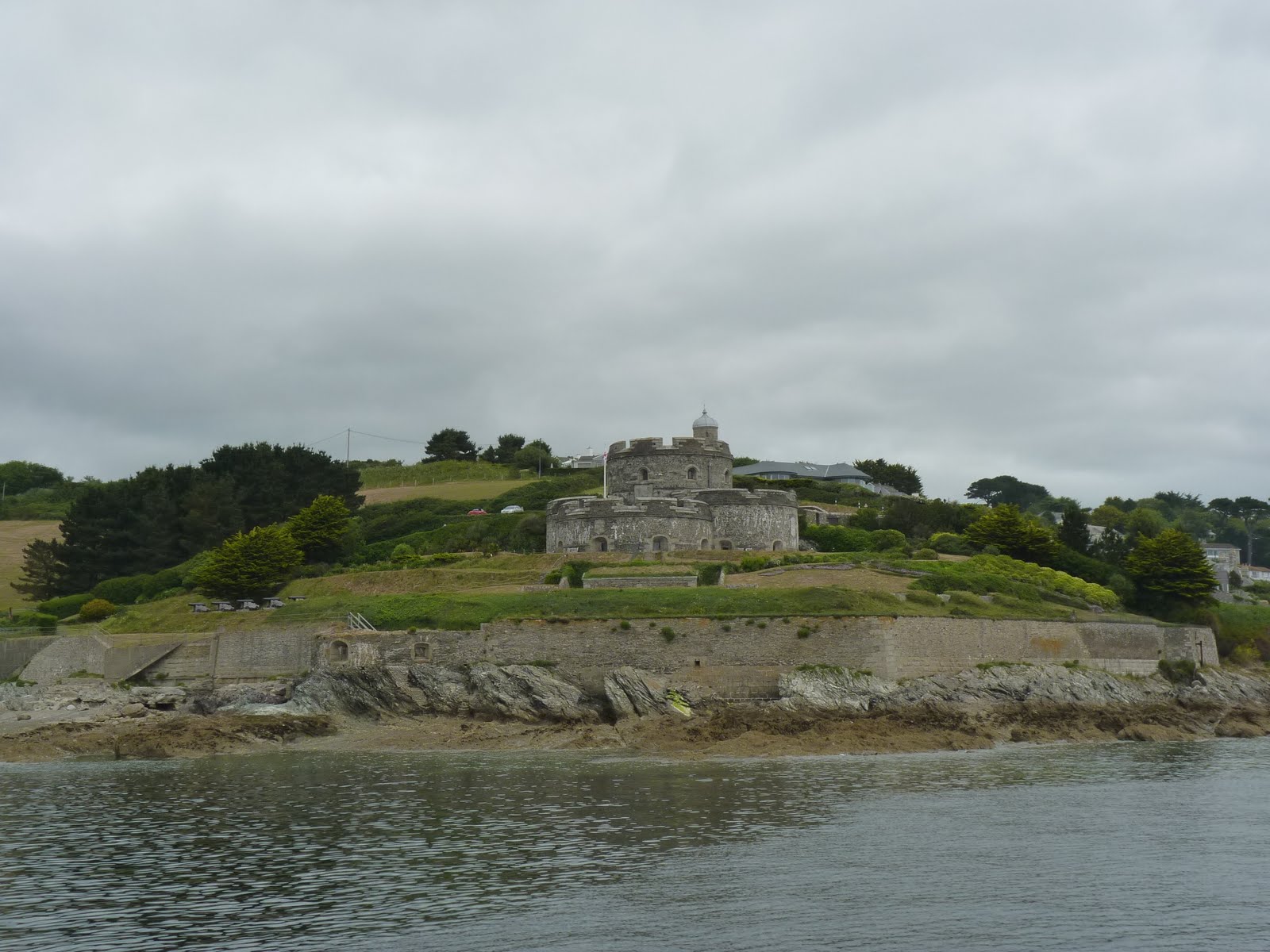
Today is a ferry trip across to Falmouth from St.Mawes harbour. Cool, but the sea was calm and we had great views of St.Mawes Castle as we passed by. The trip takes about 30 minutes, and you can see across to Pendennis Castle on the other headland. The ferry diverted to show us the cruise ship called "The World",  on which the cabins/suites/staterooms, etc are OWNED by people who do nothing but cruise around the world! He said the smallest, inside apartment cost  $1,000,000 US!

If you stay with this blog you will see how small it is compared to the one we cruised on to Norway, as they were both in Oslo at the same time, so these people had sailed from Falmouth in early June, and were up in Oslo on the 30th June, via whoknowswhere?

Falmouth is apparently the third deepest harbour in the UK, so it can take big ships, and there are also an enormous number of yachts, both motorised and sail in the marinas. You do appreciate how nice it must be in good weather to be able to sail in this area.
Got a taxi up to Pendennis castle as we weren't sure we'd find our way there ourselves and it was 2 miles anyway. It is on the headland with all the fortifications facing out to sea, with gun placements, battlements., etc.
The castle is similar to St.Mawes and has some great displays and a reproduction battle set up in one of the gun towers. Very noisy and it is set off when anyone walks in to have a look. Quite well done, but very loud. Kids would love it.
Got some supplies at the post office to send some stuff back. We are mainly sending back leaflets and maps and things like that which aren't necessarily heavy, but take up space and are easy to send,. It really does help, and already (13/7/11) some have turned up, which is interesting as we made them all surface mail.

Had coffee at the cafe and then another taxi back to the next ferry. On the wharf there was a very talented guitarist, playing very peaceful classical and popular music. He was very good and we threw some money in his case.
On the way back the ferry man went past some rock outcrops, with a navigational light on it, and there were quite a few seals laying around in the sun. Many yachts out too, and it was just a great day, and we stopped in town on the other side and had lunch in the deli.


After the naps, we had to think about packing up and heading east across to Stonehenge and over to Woking, near London and then Kent.

Penzance, Lee's 3 X great Grandmother, and St. Michael's Mount...

Tuesday, 31st May - (Catch-up)

Today we thought we'd venture down to Penzance and perhaps Land's End, which is a round trip of around 80 miles if we go that far. (There are always best intentions, but on some days when the tiredness catches you, or things take longer than you think they will, then you just have to bite the bullet and forego seeing some things.)
It was cool but sunny and we left about 9.00am and went via King Harry's Ferry. The signs all call it King Harry Ferry, but in a book on the area, it is called King Harry Floating Bridge, and it says " there has been a ferry on the site for more than 500 years, and was established by charter". It crosses King Harry's Reach, which is part of the Pilgrim's Way to St. Michael's Mount, and is named for King Henry VI, the Lancastrian king.The chain ferry was established in 1888.


It's a good drive down to Penzance, with a few windy sections, and we got some glimpses of the Mount on the way. There is an enormous car park near the waterfront, some of which is used for cars, etc for the ferry to the Scilly Isles, and we parked there, and looked for coffee first, (as you do), and then went to find St Mary's church where some of Lee's forebears were either married, baptized in or buried. Thomas Jennings and family had lived in Customs House Lane, and we asked a local where that was and she showed us, and the church was quite near, and we found some stairs leading up to where the church is.

The church itself was locked, so we wandered around the grounds, looking for headstones, and it wasn't looking hopeful but we finally found a Jennings headstone, and it was for Lee's gt.gt.gt Grandmother, Sarah Jennings, so we cleaned up some of the lettering and took some photo's.

 
This was a real treat as it means that both Lee and I have found actual headstones, and therefore tangible things which relate to our family histories. 

We then headed towards the town, with me taking photo's of doors along the way. I have become fascinated with doors, and there are so many different ones and there is an "industry" surrounding them and you can find postcards and posters in many places, with beautiful shots of all sorts of doors.
We walked down Custom House Lane, and found New Street, where Thomas Jennings was living in the 1851 census, and this led us into the main street of Penzance, which is quite steep, running down to the wharf area. Nice shops, and lots of people about, and we had our coffee in a really nice bakery, with the pervading odours of fresh bread and home-made Cornish pasties. Yum!

Tried to find the Information centre to get a street map of Penzance to perhaps help with the history, but it is closed (permanently). Took some distant shots of the Mount from the wharf area, and then headed back to the car, which by this time was one of hundreds in the carpark, and headed for the town of Marazion, which is the village across from the Mount.

 There were a lot of people around by this stage and we parked in a large area near the beach, and then you walk across quite firm sand to the causeway, which are large cobbled stones, and not easy to walk on for a distance. It was apparently half-term break for the local schools, so lots of children about.

The mount is so spectacular and mysterious looking, and so all these thousands of people were heading for it, to make the trek to the castle at the top. We used our National Trust passes, and headed for Pilgrim's Path, which is the way to the top. NOT easy, and many people were struggling, and of course some people had the most inappropriate footwear, which didn't help their cause. It is a long way to the top, but having come this far, we were determined to do it, and once you get up there, it is so worth it, just for the views, but also the castle itself which is very interesting.
 Having reached the top you then get to wander through the castle, which with all the people around, was not easy. The castle is mostly 19thC, but the church and rectory are older and some parts go back to the 16thC.
The tour is self-guided, and roped off from parts you cannot go, but you have to move with the flow and can't skip bits and get out easily.
The ramparts and courtyard at the top, at least allow some breathing room and you can take in all the scenery.

The way out was tedious because of all the people and we were stuck in a small corridor, just slowly ambling along with the mob, so it was good to be out in the fresh air again. 
Slowly picked our way down and thought of having some lunch, but there was no room at the inn, so we left to go back.

You would have thought there would be an announcement about the rising tide, but we didn't hear one, and so when we got to the causeway, water was already lapping over it and some hardy souls were now shoeless and picking their way back across to the beach. We opted for a boat ride from the castle wharf, and down some very steeps steps into the boat, and had a really nice ride back to the beach. I asked the boatman how long the tide would close the causeway, and he said eight hours, so there were already thousands up on the mount, and this ferrying would continue for some time!
The causeway before the tide came in.

Back on the beach we headed up to a small cafe and shared a fresh ham and cheese baguette, and then headed back to St.Mawes, and remembered to stop at a layby we'd seen on the way out, and got some fresh strawberries and eggs from the stall there.

All in all a good day and a sense of achievment in having done the mount.
Pasties and then strawberries with double Channel Island cream for dinner. Yummo!

Tuesday, July 12, 2011

St Mawes, and Truro, etc.

Saturday, 28th May - Huge Catch-up

St Mawes is lovely with some beautiful homes, most of which have water views and you can see the money in some of them. The town has all the basic requirements in shops, and a nice little harbour which has boat/ferry trips across to Falmouth and other destinations.
There was apparently free wi-fi in the St. Mawes Hotel, but the couple of times I went to look, it was packed with people so I ended up sitting in the car on top of the headland and getting a signal, probably from Falmouth across the water. It is great tho, to be able to do our own thing and have a kitchen to just cook up whatever we like.

Monday, 29th May

We decided to go into Truro, which in one of the guide books at the flat, said it was a good place to visit if the weather was not good. We went early, as it was a bank holiday weekend, and likely to be lots of traffic. We got there about 9.15am, having gone around the long way by road, as we hadn't yet worked out the ferry crossing at the Fal river, and we thought we could do it on the way back. Found a carpark and all seemed deserted, but we had a good look around the city, which is very attractive with a good mix of old and new, and some interesting shops. We needed to get some more polo shirts as some had been ruined by the washing they did for us at the Edward Hotel in Gloucester, and we got some things for Ollie as well.


Came back via the short route, and the King Harry Ferry, which is reached via a pleasant drive through and estate with a National Trust garden named Trellissick, which we will go back to. The road down to the ferry is narrow and you have to wait in line, and not park in certain places or the cars coming off the ferry cannot get past as they come off. It is a very efficiently run outfit and you are soon on board, and the chain driven ferry takes all of 5 minutes to cross the water, and then you are quickly up the other side and away.

We're baaaaack!!! - so stay tuned

We intend to finish this story of our trip, which would have already been done, except for the lack of internet access in various places.

So, next is Truro, in Cornwall...